
Overview
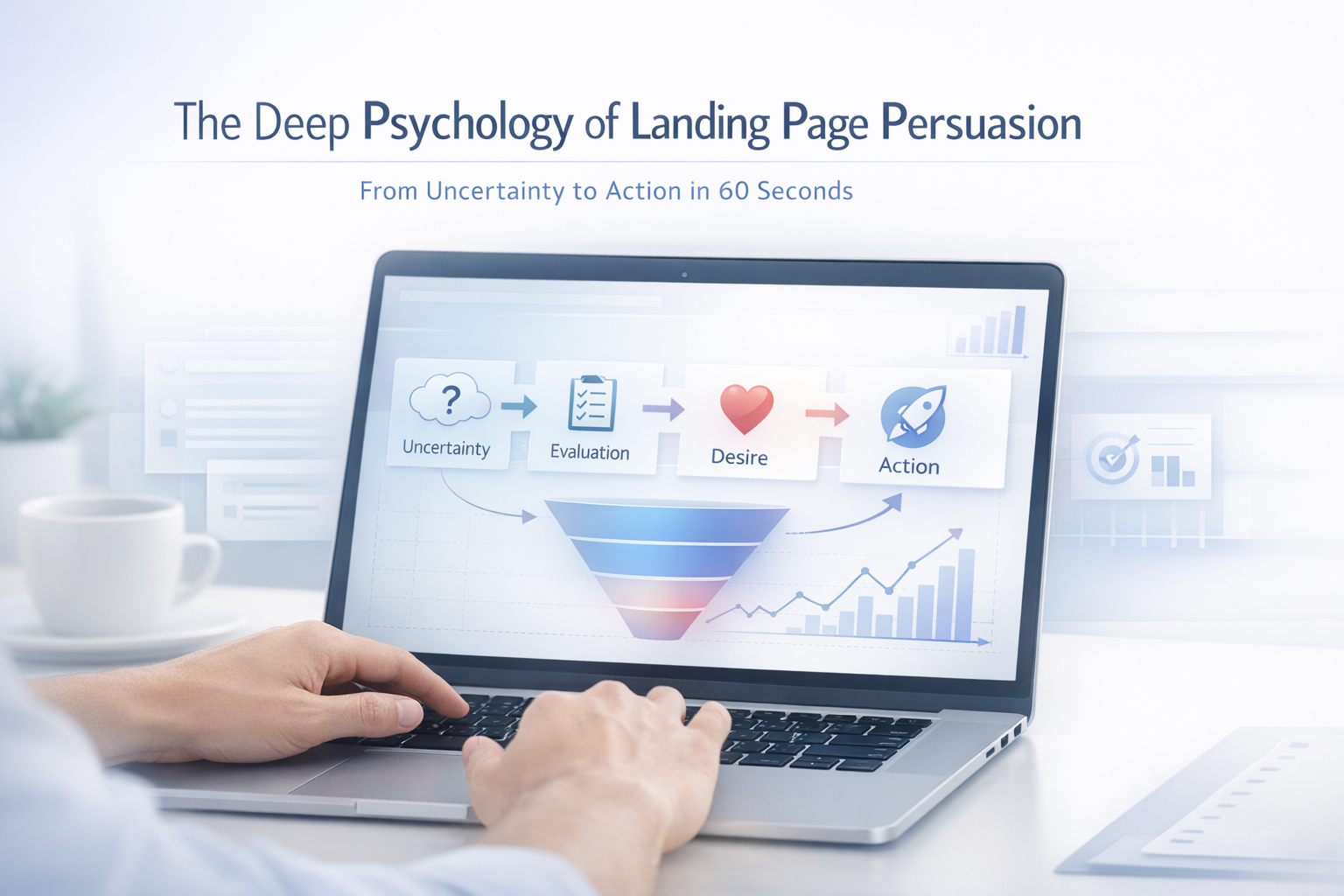
The report delves into the psychological journey a visitor undertakes on a landing page, from initial trust judgments to final actions. It outlines key persuasion mechanisms, such as social proof and authority, and explains how trust is built layer by layer. The document also discusses risk reduction strategies and value perception engineering, highlighting the importance of cognitive ease. Advanced insights into identity, strategic friction, and the reciprocity window are provided, emphasizing the dual-track nature of persuasion.
Inside This Report
The Visitor Psychology Journey: Arrival Through Action
Explores the seven-stage psychological sequence from initial orientation to post-decision rationalization.
The Persuasion Mechanism Map
Details various persuasion mechanisms targeting emotional and rational systems.
Belief Formation Architecture: How Trust Builds Layer by Layer
Describes how trust is established through distinct layers on a landing page.
Risk Reduction System: A Comprehensive Taxonomy
Outlines strategies to reduce perceived financial, performance, and security risks.
Value Perception Engineering: Framing, Anchoring, and Contrast
Explains how perceived value is constructed through strategic framing and anchoring.
Cognitive Ease Framework: Clarity, Layout, and Hierarchy as Conversion Drivers
Highlights the role of processing fluency in enhancing trust and conversion rates.
Copy, Layout, Psychology — and the Universal Eight-Section Architecture
Discusses the interaction between copy and layout in creating effective landing pages.
Persuasion Failure Taxonomy: Why Pages Fail to Convert
Identifies common friction categories that hinder conversion.
Advanced Insights & Conclusion: The Architecture Underneath Persuasion
Presents advanced insights into identity, strategic friction, and the importance of cognitive ease.
Who Is This For?
This report is ideal for digital marketers, UX designers, and conversion optimization specialists looking to enhance landing page effectiveness.
Ready to dive in?
Download the full report Free PDFMore Research
Why Duplicate Google Demand Gen Campaigns Perform Independently
This report delves into the mechanics of Google's Demand Gen platform, focusing on how duplicate campaigns operate independently. It examines auction processes, machine learning behaviors, and optimal campaign structures for future success.
View Report →Align Your Ad Copies with Google's Objective (What Google Rewards / How to Build the Iterable RSA System)
This report explores how aligning ad copies with Google's objectives can enhance ad performance. It covers Google's auction mechanism, Quality Score components, and effective RSA systems.
View Report →Meta Threads Algorithm: A Reverse-Engineering Report
This report reverse-engineers the Meta Threads algorithm, detailing its core rules, key criteria, and strategies to optimize engagement. It combines evidence from official Meta sources and inferences drawn from patterns and creator experiments.
View Report →